 |
| Photo: FCA Media website. |

No matter what you drive, we’re driven to help you get more enjoyment out of automotive life and culture.
Showing posts with label automotive technology. Show all posts
Showing posts with label automotive technology. Show all posts
Thursday, October 4, 2018
Automotive safety technology might save your life… but it might not save you much money on your car insurance, study finds


Monday, September 24, 2018
Vintage car with no Bluetooth? Amazon’s new Echo Auto could be a good solution.
 |
| Photo: Tiffany Bailey (Wikimedia Commons). |
As long as your car stereo has a 3.5mm auxiliary input, you’ll be able to plug in the new Amazon Echo Auto, which can then connect to your smartphone through the Alexa app, enabling you to use Alexa voice commands to access features available through your existing phone plan, such as music, navigation, and hands-free calling.
Wednesday, September 12, 2018
‘Off-road cruise control?’ Ford’s new Trail Control feature for the F-150 Raptor actually sounds like a good idea—but maybe they should position it a little differently
 |
| Photo: Ford Media Center. |
By Bill Hayward
If you’re like me, you use cruise control as a means of restraint in higher-speed situations, to try to keep the velocity a little lower and decrease the odds of your driving pleasure being interrupted by red-and-blue lights when you’re on a long roadtrip in your favorite silky-smooth, miles-devouring highway cruiser. Sunday, July 22, 2018
Fear the pinch: The market for technology to keep us safe from the hazards of automotive power windows is growing 10 percent per year, report says.
 |
| Infographic: Technavio. |
Thursday, July 12, 2018
So which U.S. automaker might be getting ready to make motorcycles with enhanced location-based services?
 |
| Dodge Tomahawk concept motorcycle. Photo: Elambeth (posted to Wikimedia Commons). |
What was odd about the press release is that the U.S. automaker involved was not named. But the press release did tease one tidbit: it said that the manufacturer will use Comtech’s navigation product “for two of its top vehicle programs, including motorcycles.”
Wednesday, July 4, 2018
Connected-vehicle tech company Autotalks scores a reported ‘several million dollar’ investment from Hyundai.
 |
| Photo: Hyundai media center. |
Yesterday, Autotalks revealed that they have embarked on a major new collaboration—this time with a major global automaker. Through a direct investment in Autotalks, Hyundai Motor Company seeks to drive chipset technology for connected cars into its next generation.
Wednesday, June 13, 2018
Does size matter when it comes to safety? MINI Hardtop 2 Door bags IIHS safety award for criteria that include ‘nearly avoiding’ a collision, BMW Group says.
 |
| Photo: BMW Group media website. |
Thursday, June 7, 2018
Drivers of new Cadillacs will soon be able to say, ‘Look, Ma—no hands!’
 |
| Photo: GM media website. |
Monday, June 4, 2018
To sell the new Focus lineup, Ford is asking Europeans to talk to a sign.
 |
| Photo: Ford Media Center. |
Although Ford announced in April that that they will discontinue U.S. sales of all of the Focus lineup except the Focus Active crossover, the situation is different across the pond in Europe, where Ford began pitching an "all-new" lineup of four flavors of Focus this spring.
 |
| Photo: Ford Media Center. |
Now, imagine the conversation around the conference room table as the marketing campaign to support the European launch of the lineup, which includes the Focus ST, the Focus Vignale, the Focus Titanium, and the Focus Active, was under discussion. Did some marketing guru actually say, "Hey, let's have people talk to a sign outdoors?"
Yeah. Of course. That sounds like a great way to sell a car.
Saturday, June 2, 2018
A (partially, I hope) driverless future: here is what intrigues me.
 |
| Self-driving Chevy Bolt. Photo: GM Corporate Newsroom. |
Monday, May 28, 2018
BMW launches wireless plug-in hybrid charging for German market, with other regions soon to follow.
 |
| Photo: BMW Group PressClub Global. |
Sunday, May 6, 2018
New Toyota Research Facility to Test Automated Driving Scenarios 'Too Dangerous for Public Roads'
 |
| Photo: Toyota media website. |
Saturday, April 28, 2018
Autonomous Vehicles and Smart Highways: Author Bennecke's Fictional Vision Sorts Out the Worst—And Best—Possible Futures

This holds true not only at the U.S. level, but also globally. According to survey findings from BCG and the World Economic Forum, as summarized by Statista, half of survey participants from ten countries say they would not feel safe in a self-driving car. Forty-five percent said, further, that they want to be in control at all times when driving.
The ambivalence at the individual and societal level is affecting creative works as well. And Civil Terror: Gridlock (Jaytech Publishing, March 2018), the first installment in a new series of novels by civil engineer turned fiction author J. Luke Bennecke, is one of the latest examples.


What if traffic jams were not only a nuisance but also an actual source of danger?
With self-driving cars being tested across the world and computer systems at the helm, this possibility is not as far-fetched as it might have once seemed. Bennecke uses his wealth of knowledge on the subject to take a fictional dive head first into the question of what might happen if we, as a society, fail to account for the risks associated with the technological advancements of autonomous vehicles in his new novel.
Kicking off what will eventually be a four-book series, Civil Terror: Gridlock centers on Civil Engineer Jake Bendel. Far from the usual genre hero, Bendel works for the federal government where he has designed and implemented a national self-driving network. For three months fatal accidents and traffic congestion across the U.S. become all but obsolete.
But when a terrorist cell weaponizes Jake’s system, suddenly the technology that was his success story is putting many lives on the line. Bendel and his unlikely partner, a rogue FBI agent named Jose Cavanaugh, must play a deadly game of strategy with a terrorist organization to try and head them off at the pass. When the terrorists’ activities threaten the life of Bendel’s adult daughter, the game becomes even more serpentine, and he must make an impossible decision to save her life or save millions of American lives at risk on freeways everywhere.
Tuesday, April 17, 2018
"Alexa, Warm Up My Car": Kia Adds Amazon Alexa Remote Voice Controls to Several Models
 |
| Kia Optima Hybrid. Photo: Kia media website. |
Kia Motors America announced on Monday that they have added the ability to remotely control a number of functions, such as starting and stopping the engine or heating and cooling car interiors, using simple voice commands.
The new features are enhancements of Kia's UVO Skill system, UVO being an acronym for "Your Voice." UVO Skill also allows owners to lock doors, sound the horn and flash the lights, and start and stop charging a Kia plug-in or electric vehicle.
Saturday, April 14, 2018
Mazda Scores Innovation Award for SKYACTIVE-X Compression-Ignition Engine

The first is car model design aesthetics. In a world where you increasingly need to play "find the badge" to identify the manufacturer of that latest boring crossover or lookalike Sonata- or Fusion-shaped fastback sedan, Mazda takes the intractable reality of the aerodynamic and safety-driven basic shapes that the industry feels obligated to produce today and manages to produce standout designs that are stunning enough to make a car enthusiast drool.
Mazda is also pushing the edges outward on the technology and research-and-development side. To name just a few examples, Mazda has made automotive technology news recently with a partnership with Denso and Toyota for electric vehicle R&D, an effort to obsolete the lead-acid starter battery with a lithium-ion replacement, and their latest public triumph: a Gold Edison Award for the SKYACTIV-X compression-ignition engine.
Monday, March 26, 2018
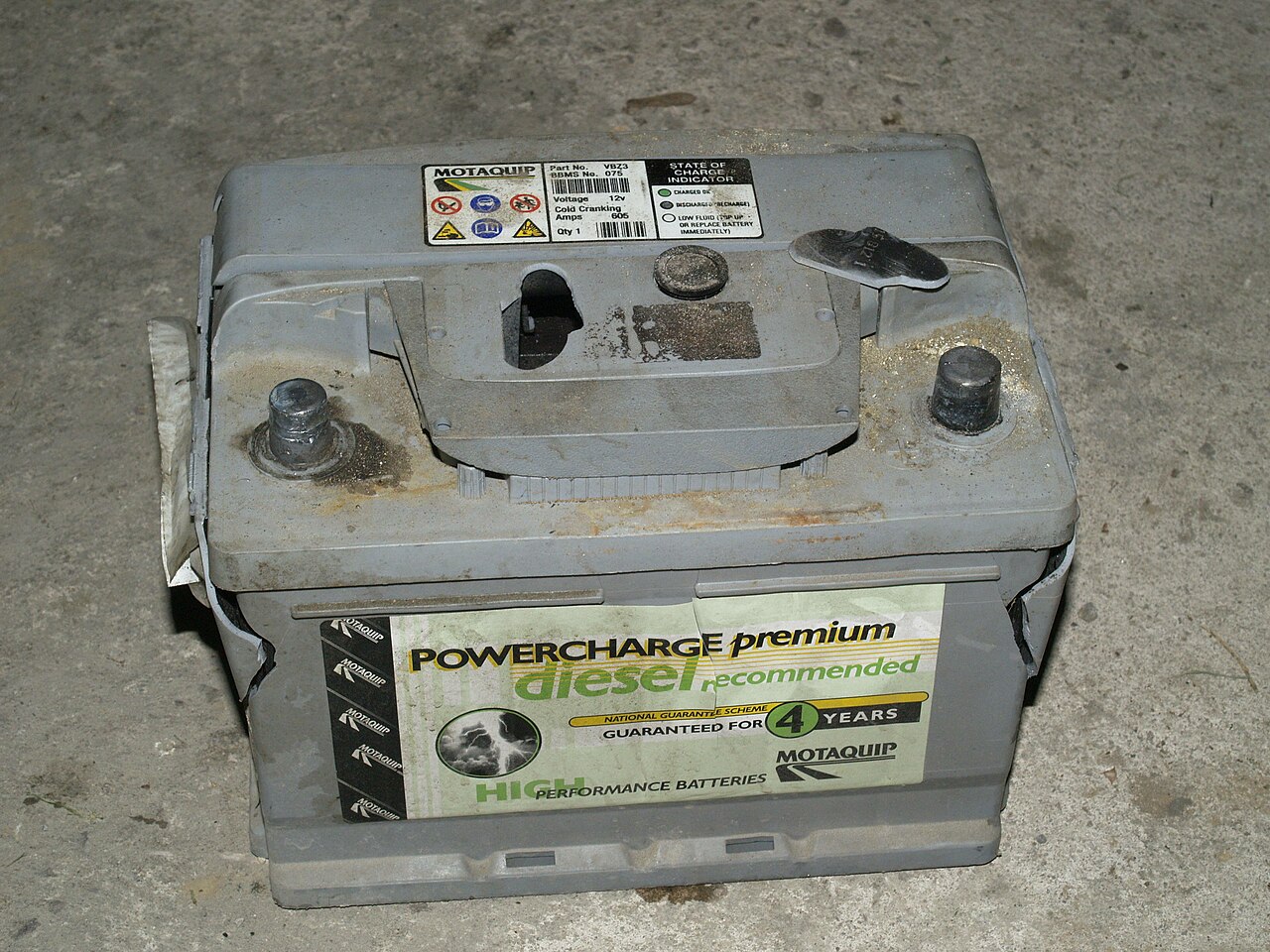
Get Ready to Say Buh-Bye to That Lead-Acid Battery in Your Car—if Mazda Has Their Way
 |
| Photo: Towel401 (Wikimedia commons). |
Lithium-ion batteries offer a promising alternative to conventional lead-acid car batteries, as environmental regulations in some regions restrict the use of lead and engineers aim to reduce vehicle weight for improved fuel economy. But their application in motor vehicles so far has been limited due to the need for car batteries to withstand the high temperatures of the engine room and the potential impact forces of a collision. With this new project, Mazda, ELIIY Power and Ube Industries will combine their technical strengths to overcome such issues.
Subscribe to:
Posts (Atom)